Earlier this year I spent an afternoon on the phone with a head of digital learning at a U.S. community college system. She was trying to budget for a credentialing rollout — around 10,000 microcredentials a year across a few campuses — and she had three vendor quotes in front of her, all of them confusing in different ways. One quote was a single annual figure with no breakdown. Another listed a per-recipient rate that didn't match the per-credential count she actually needed. The third had a setup fee and an annual minimum that together looked higher than her first-year credential volume warranted.
Her question, eventually, was the one nobody in the industry seems to want to answer cleanly: "What does this actually cost?"
So I built a model. Not a benchmark in the formal sense — there's no standard contract anyone publishes — but a side-by-side picture of what an institution issuing 10,000 credentials per year would actually pay across the five platforms that come up most often in U.S. and international procurement: Credly, Accredible, Certopus, Sertifier, and POK - Proof of Knowledge. All the numbers below are pulled from publicly available pricing pages, vendor disclosures, G2/Capterra/Vendr datasets, and customer-reported figures from 2025–2026. Where pricing is quote-only or opaque, I've said so plainly.
This isn't a ranking. It's an attempt to make the math visible.
IN THIS ARTICLE
- Why pricing in this market is so hard to compare
- The three cost components nobody talks about
- Platform-by-platform pricing analysis
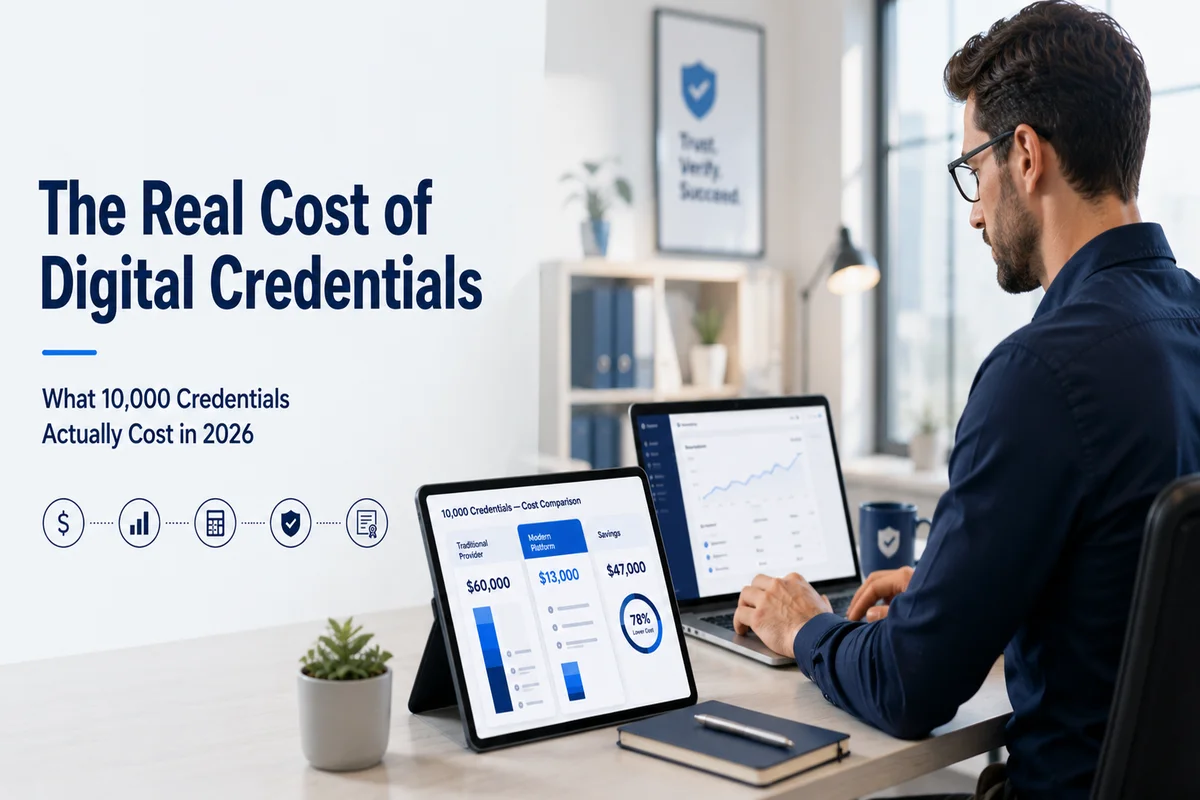
- The 10,000-credential scenario, side by side
- What the numbers don't tell you
- Five procurement questions worth asking
Why pricing in this market is so hard to compare
Digital credentialing has a transparency problem. Two of the largest platforms — Credly and Accredible — don't publish enterprise pricing publicly. To get a real number, you have to fill out a form, get on a call, and wait for a quote that depends on your sector, volume, and how good you are at negotiating. Vendr's pricing intelligence dataset, which aggregates anonymized enterprise contract data, reports Credly annual contracts ranging from around $50,000 to over $200,000 for large-scale deployments, with smaller deployments at the $1,500–$7,500 range. Accredible's range, also from Vendr, sits at roughly $3,000 to over $50,000 annually.
That spread tells you what you need to know: there is no single price. There is what you can negotiate.
Beneath that opacity, there are three structural pricing models that compete in this market, and they don't compare cleanly:
- Per-recipient pricing (Accredible): you pay for each unique person who receives credentials, but they can earn unlimited credentials within the year
- Per-credential or volume-tier pricing (Credly, Certopus, Sertifier, POK): you pay based on how many credentials are issued
- Hybrid models with setup fees, annual minimums, and feature gating that change the effective cost significantly
A "lower price per credential" can mean a higher total bill if the minimum commitment is bigger than your actual volume. A "no setup fee" can be misleading if onboarding consulting is charged separately. Apples and oranges, priced in dollars.
The three cost components nobody talks about
When institutions ask me to review a credentialing quote, three line items are usually missing from the conversation:
1. Setup and onboarding fees
Several platforms charge a one-time setup fee that doesn't appear on the public pricing page. Reported figures: Credly setup costs reported by Vendr range from $2,500 to $5,000 for small deployments and higher for enterprise. Accredible reports no separate setup fee in its published plans, but enterprise tiers often include implementation costs negotiated separately. POK publishes a $0 setup fee on its public pricing.
2. Annual minimums
Annual minimum commitments are the silent budget killer. If a platform quotes you $1.50 per credential but requires a $10,000 annual floor, and you only issue 4,000 credentials in year one, your effective cost is $2.50 per credential, not $1.50.
3. Feature tier gating
LinkedIn sharing, custom branding, API access, SSO, advanced analytics, multi-workspace support — these sit at different tiers across platforms. Capterra customer reviews consistently flag this: one Accredible customer noted that despite paying just under $1,000/year, recipients couldn't fully share badges to LinkedIn without upgrading to enterprise. That's a real example of "the headline price is not the actual price."
Platform-by-platform pricing analysis
Credly (by Pearson)
Credly does not publish self-serve pricing. The clearest data we have comes from Vendr's anonymized contract database and customer-reported figures aggregated by independent reviewers:
- Reported pricing: approximately $1,500/year for 500 badges, scaling to $7,500/year for 2,500 badges in smaller deployments
- Enterprise contracts: $50,000 to over $200,000 annually for high-volume programs
- Reported per-badge cost: approximately $2 to $5 depending on volume
- Setup fee: reported around $2,000–$5,000
- Annual minimum: typically required; annual contract only, no monthly billing
- Free plan: none
Credly's positioning is enterprise corporate badging with an unmatched employer-side network. The premium pricing buys network access. For institutions where that network is the primary value, it can make sense. For institutions issuing academic credentials where the employer network matters less, the cost-benefit shifts.
Accredible
Accredible publishes plan names and structure but not full prices on its pricing page. The model is per-recipient, with three tiers (Launch, Connect, Growth) plus enterprise. Per Vendr and Capterra customer data:
- Essentials/Launch tier: approximately $3,000–$6,000 annually for up to 1,000 recipients
- Growth tier: $8,000–$20,000 annually for 1,000–10,000 recipients
- Enterprise: $20,000–$50,000+ annually
- Setup fee: reportedly around $1,500 for some plans; enterprise implementation negotiated separately
- Annual commitment: required; monthly billing only with annual contract
- Free plan: none (20-credential free trial only)
The per-recipient model is genuinely advantageous when each learner earns multiple credentials in a year. It's less efficient when one credential per person is the norm.
Certopus
Certopus is positioned as a more accessible alternative, especially in Asia-Pacific markets. Public pricing reflects this:
- Lite plan: starts around $25/month, limited to 50 certifications/month
- Growth plan: approximately $75/month for 50 certificates or badges
- Plus and Enterprise: custom pricing
- Setup fee: none reported
- Free plan: free trial available; no permanent free tier
Certopus is competitive at the smaller end but, like most volume-tier platforms, the cost climbs as you move into the thousands of annual credentials.
Sertifier
Sertifier follows a similar volume-tier model to Certopus:
- Free plan: available for up to 5 recipients (very limited)
- Standard plan: approximately $35/month for 100 certificates
- Enterprise tier: custom pricing for over 2,000 badge issuances annually
- Add-ons: branding customization and priority support are paid extras
Sertifier is a reasonable mid-market choice, with the caveat that branding and integration features sit in paid add-on layers.
POK - Proof of Knowledge
POK is the only platform in this comparison that publishes its full pricing model publicly and offers a permanent free unlimited tier:
- Free unlimited plan: $0 — unlimited Open Badge 3.0 web-based credentials, no user caps, no expiration, no credit card required
- NFT blockchain credentials: $0.80–$1.50 per credential, depending on volume
- Setup fee: $0
- Annual minimum: none
- Contract: no mandatory contracts; pay only for what you issue
The free tier covers the standards-based credential layer (Open Badge 3.0, W3C VC-compatible, ISO 27001 and SOC 2 certified) at no cost. The paid layer is NFT issuance on public blockchains (Polygon, LacNet), which adds permanent independent verification — credentials remain valid even if the issuing institution or POK itself ceases to operate. POK reports more than 1,500,000 credentials issued and 1,100+ institutions across 19 countries. For the architectural context behind this model, the guide to verifiable credentials infrastructure covers what blockchain anchoring actually does in practice.
"POK is the only major platform in 2026 with a permanent free unlimited tier and fully public pricing. Every other vendor in this comparison requires a sales call to get a real number."
The 10,000-Credential Scenario, Side by Side
Here is the comparison most institutions actually need: what would it cost to issue 10,000 credentials in year one across these five platforms? The figures below are mid-range estimates based on publicly available and reported data. Final pricing depends on negotiation, region, sector, and bundled features.
Credly
Setup fee: ~$2,000–$5,000
Annual minimum: Typically required
Estimated Year 1 total: $22,000–$55,000
Accredible
Setup fee: ~$1,500 (varies)
Annual minimum: Annual contract required
Estimated Year 1 total: $15,000–$25,000
Certopus
Setup fee: None reported
Annual minimum: Tier-based monthly plans
Estimated Year 1 total: $8,000–$15,000
Sertifier
Setup fee: None reported
Annual minimum: Tier-based monthly plans
Estimated Year 1 total: $7,000–$14,000
POK - Proof of Knowledge
Setup fee: $0
Annual minimum: None
Estimated Year 1 total: $0–$15,000 (depending on whether institutions use the free Open Badge 3.0 tier, NFT blockchain credentials, or a combination of both)
Three real-world scenarios
SCENARIO A — A 500-CREDENTIAL PILOT
A training provider issuing 500 credentials in year one would pay roughly $1,500–$3,000 on Credly, $3,000–$6,000 on Accredible (limited by the minimum tier), $300–$900 on Certopus or Sertifier (depending on plan), and $0 on POK's free tier or roughly $400–$750 on POK NFT credentials. At this volume, the gap between free and the cheapest paid alternative is significant.
SCENARIO B — 10,000 CREDENTIALS AT A MID-SIZED UNIVERSITY
This is the original modeled scenario. The cost spread is wide: from $0 on POK's free tier to $55,000 on Credly enterprise. The decision driver here is not just price — it's what each tier actually delivers (employer network, NFT permanence, design tooling, support).
SCENARIO C — 100,000 CREDENTIALS IN A NATIONAL PROGRAM
At national-program scale, Credly enterprise contracts can exceed $200,000 annually. Accredible enterprise sits in the $50,000+ range. Certopus and Sertifier would require custom quoting and are less common at this volume. POK's volume-tier model at $0.80/credential brings 100,000 NFT credentials to roughly $80,000, with the free unlimited tier remaining at $0 for any web-based portion of the issuance. For programs of this scale, the multi-year TCO gap can run into hundreds of thousands of dollars.
What the numbers don't tell you
A pure cost comparison is incomplete without three things that don't show up in the spreadsheet:
1. The employer network
Credly's network of corporate issuers and recruiters — including IBM, Microsoft, AWS, and many large certification bodies — is genuinely unmatched. If your credential's primary purpose is brand recognition inside U.S. corporate hiring, that network has value that isn't captured in a per-badge price.
2. Verification permanence
If your institution stops paying a centralized platform, what happens to the credentials your learners already earned? On hosted platforms, the verification depends on the platform continuing to operate. On blockchain-anchored platforms, the credential can be verified independently on a public ledger even if the issuer or platform disappears. For institutions issuing diplomas that need to remain verifiable for decades, this is a meaningful design decision.
3. Standards compliance
The OpenBadge 3.0 compliance analysis on this site shows that not every platform that claims to support the standard has earned the 1EdTech certification to back it up. A cheaper platform without verifiable standards compliance can be more expensive over a five-year horizon if credentials need to be reissued for interoperability.
Five procurement questions worth asking before signing
- What is the all-in first-year cost, including setup fees, onboarding consulting, and annual minimum, in writing?
- What is the per-credential cost at our actual annual volume — not the headline volume tier?
- Which features sit behind which tier? Specifically: LinkedIn sharing, custom domain, API access, SSO, advanced analytics, multi-workspace, expiration and renewal workflows.
- If we leave the platform, what happens to credentials already issued? Are they verifiable independently of the platform?
- Is there a published 1EdTech OpenBadge 3.0 certification? Can you share the registry link?
The platform that answers those five clearly is the one worth shortlisting. Vagueness on any of them is itself a signal.
Methodology and sources
This analysis is based on publicly available pricing pages and disclosures from each vendor; the Vendr enterprise pricing dataset; Capterra, G2, and TrustRadius customer-reported figures; and 2025–2026 published comparisons by independent reviewers including Certifier and others. Where vendor pricing is quote-only and no range was reported, this has been stated explicitly rather than estimated.
No vendor was given pre-publication access to this article. No vendor compensated for inclusion. POK's pricing is the only one in this comparison that is fully publicly published on the vendor's own pricing page; all other figures are reported ranges from independent sources.
For broader platform context, Jordan Lee's 2026 platform overview covers positioning beyond pricing, and Olivia Turner's OpenBadge 3.0 compliance review covers the standards layer. Stefan De Villiers' piece on the new architecture of learning provides the global higher-education context for why scalable credentialing pricing matters now.