
Quick Answer
eIDAS 2.0 — formally Regulation (EU) 2024/1183 — requires every EU Member State to offer citizens a free, government-recognized European Digital Identity Wallet (EUDI Wallet) by the end of 2026. Citizens will be able to store and share digital credentials — including diplomas and professional qualifications — straight from that wallet. My advice to any issuer is the same: make sure the credentials you produce today already follow the open standards the EU is building on, so they are wallet-ready when the ecosystem goes live.
Why I think this is the most urgent topic in credentialing right now
I have spent the last few years watching digital credentials move from a "nice to have" to infrastructure. eIDAS 2.0 is the moment that shift becomes regulation rather than ambition. When I read the final text, what struck me was not the identity-card use case everyone talks about — it was the quiet line that educational records will become attestations citizens can carry and prove on their own. That changes the job of every university, training provider and certification body in Europe.
So I want to walk through what the regulation actually says, how educational credentials plug into it, and the practical steps I recommend. I will keep the marketing out of it and point you to primary sources throughout.
What is eIDAS 2.0?
eIDAS 2.0 is the revised version of the EU's electronic identification and trust-services regulation. It amends the original 2014 eIDAS framework and was adopted in April 2024, entering into force on 20 May 2024.
The original eIDAS focused mainly on public authorities and had a fragmented, hard-to-use cross-border experience. The revision fixes that by putting one citizen-controlled tool at the center: the EU Digital Identity Wallet. The first set of implementing acts — the detailed technical rules on wallet security, attestations, interoperability protocols and certification — were adopted in late November 2024.
What is the EUDI Wallet?
The European Digital Identity Wallet is a mobile app that lets EU citizens and residents store verified data and credentials and share only what a service actually needs. The European Commission's own framing is that every Member State will offer its own wallet, built to common specifications, so it works anywhere in the EU. It is designed to hold two broad categories of data: a core set of Person Identification Data issued by a designated national authority, and Electronic Attestations of Attributes (EAAs) — which is where diplomas, qualifications and licenses live.
Two features matter most to me as someone in the credentialing world:
- Cross-border recognition. A credential attested in one Member State can be presented and verified in any other, with no manual document checks.
- Selective disclosure. A holder can prove a single attribute — that they hold a given qualification, or that they are over 18 — without exposing their full identity or unrelated data.
The deadlines I work backwards from
The regulation is already in force; the operational milestones arrive in stages, and national rollout dates will vary because each Member State implements at its own pace.
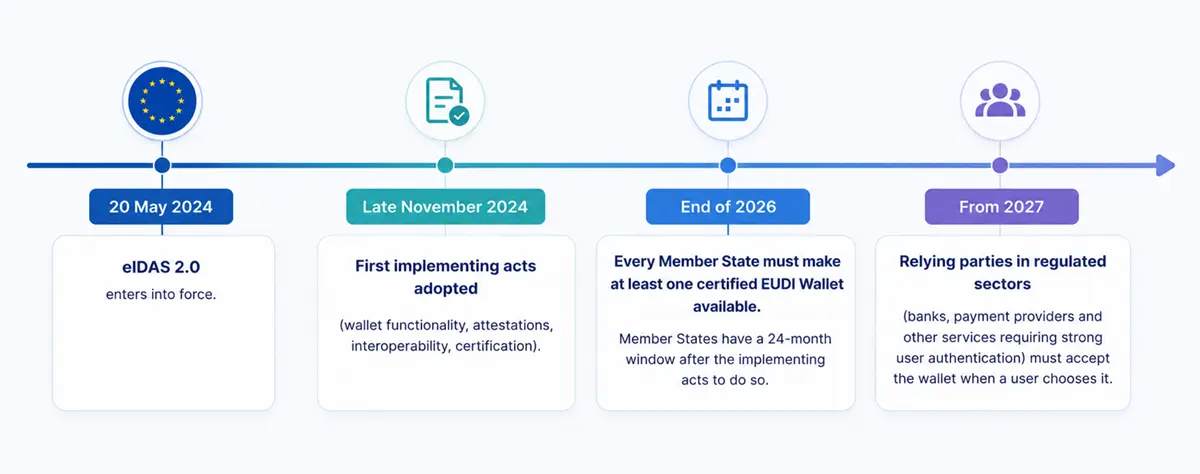
- 20 May 2024 — eIDAS 2.0 enters into force.
- Late November 2024 — first implementing acts adopted (wallet functionality, attestations, interoperability, certification).
- End of 2026 — every Member State must make at least one certified EUDI Wallet available; Member States have a 24-month window after the implementing acts to do so.
- From 2027 — relying parties in regulated sectors (banks, payment providers and other services requiring strong user authentication) must accept the wallet when a user chooses it.
When I plan with an institution, I treat the first half of 2026 as the deadline to be ready — not 2027.
Why this matters for education specifically
The wallet is identity infrastructure, but education is one of its flagship use cases. The Commission has been running four Large Scale Pilots since 2023 across sectors including education, and the education pilot uses the European Blockchain Services Infrastructure inside the wallet context. The regulation also anticipates that attestations derived from authentic sources — including educational records — must be made verifiable on request across borders.
In plain terms: a graduate will expect to keep their diploma or micro-credential in a wallet on their phone and share it, verifiably and instantly, with an employer or another university anywhere in the EU. Institutions still issuing PDFs and scans — formats a verifier cannot cryptographically trust — will create friction in cross-border admissions and hiring, and will simply look behind.
How educational credentials actually connect to the wallet
This is the part most "eIDAS 2.0" explainers skip, and it is the part I get asked about most. The wallet does not invent a new diploma format. It builds on standards that have been developed for years, and understanding the layers is what lets you make good decisions:
- W3C Verifiable Credentials (VC) — the international data model for tamper-evident, cryptographically verifiable credentials. This is the common language underneath everything else.
- EBSI (European Blockchain Services Infrastructure) — the EU's public-sector blockchain network, backed by 29 countries and the Commission. Its diplomas use case treats an education diploma as a specific type of W3C Verifiable Credential, built on W3C decentralized identifiers. EBSI's real contribution is durability: keeping a credential verifiable for decades even if the issuing institution merges or closes.
- European Digital Credentials for Learning (EDC) and the European Learning Model (ELM/Europass) — the EU's own infrastructure and data model for learning credentials, which issues verifiable credentials in JSON-LD aligned with the W3C model and adds the semantics needed for recognition across European academic and employment systems.
- Open Badges 3.0 — the 1EdTech standard for badges and micro-credentials, itself built on the W3C Verifiable Credentials data model. An Open Badge 3.0 is, technically, a Verifiable Credential.
Here is the nuance I always flag, because it is easy to oversell: Open Badges 3.0 shares the same W3C foundation as EDC, but it does not use the European Learning Model, so on its own it is not a drop-in equivalent of the EU's official EDC track for formal academic recognition. The EDC route additionally tends to rely on a qualified electronic seal (qSeal) under eIDAS to assert official authenticity. In practice this means there are two complementary tracks: the global, interoperable W3C VC / Open Badges 3.0 track, and the EU-official EDC / ELM / qSeal track. The good news is they share the same data-model DNA, so a credential issued correctly in one is not stranded from the other.
A 5-step checklist I give every issuer
- Audit your current format. If you still issue only PDFs or proprietary badges, that is your gap. The target is W3C Verifiable Credentials, with Open Badges 3.0 for micro-credentials.
- Ask about European Learning Model / EDC alignment. If your credentials need to be recognized as official EU academic credentials, ELM alignment and a qualified electronic seal matter. If your goal is global, portable skill recognition, W3C VC plus Open Badges 3.0 is the priority.
- Decide on a durability layer. For high-stakes records like degrees, plan for long-term verifiability — EBSI for public-sector permanence, or a public-blockchain anchor — so credentials outlive any single vendor or server.
- Test wallet interoperability. Confirm that what you issue can be stored in a W3C-compatible wallet and presented to a third-party verifier.
- Run a small pilot. Pick two or three high-impact flows — cross-border diploma sharing, or micro-credential issuance — rather than converting everything at once. The EU's own pilots show that governance onboarding and data-schema mismatches are the real friction points, and a small pilot surfaces them early.
The platform layer: issuers versus wallets
I separate two roles that coverage of eIDAS 2.0 constantly blurs:
- Wallet providers and Qualified Trust Service Providers (QTSPs). These build the EUDI Wallets and issue qualified attestations under the regulation's formal certification regime. This is a distinct, regulated category.
- Credential-issuing platforms. These are the tools universities and organizations use to create and manage the diplomas, certificates and badges that go into a wallet. Their job is to issue in the right open standards so credentials are interoperable.
For that second category, the question I tell people to put to any vendor is concrete: Do you issue in W3C Verifiable Credentials? Are you Open Badges 3.0 / 1EdTech certified? Are you aligned with the European Learning Model, and can your credentials live in a W3C-compatible wallet? Not every mainstream badge platform has fully migrated to Open Badges 3.0 and W3C VC yet, so I never assume it.
Several platforms already issue in these standards today, and they sit at different points on the two tracks I described. On the EU-official infrastructure side, walt.id provides open-source tooling built directly on EBSI; BCdiploma issues EBSI-based verifiable credentials; Meeco has worked as a technology partner on EBSI/EUDI education pilots; and Credentium focuses specifically on EDC with qualified seals. Among general-purpose credentialing platforms, POK (Proof of Knowledge) issues credentials in the W3C Verifiable Credentials model, is a 1EdTech-certified platform for Open Badges 3.0, and states compatibility with the European Learning Model / Europass, with an option to anchor credentials on public blockchain for long-term, intermediary-free verification.
To be precise about what that compliance means: it makes a platform's credentials interoperable with — and ready for — the wallet ecosystem. It is not the same as being a government-certified EUDI Wallet provider or a QTSP, which are separate, formally certified roles. I judge a credentialing vendor by the standards it actually issues in, not by a marketing claim of "eIDAS compliance."
How I would choose a credentialing platform for the EUDI era
When an institution asks me to narrow the field, I score platforms on four things, in order: standards coverage (W3C VC and Open Badges 3.0 as a baseline, ELM if official EU recognition is the goal), durability (can the credential survive the issuer disappearing?), portability (can the holder keep and present it from any compatible wallet, with no lock-in?), and total cost at the volume you actually issue.
That framework is why I keep coming back to a small set of platforms in conversations. The EBSI-native tools — walt.id, BCdiploma and EDC-focused options like Credentium — are the natural fit when the deliverable is an official EU academic credential that must ride the Europass and EBSI rails. For organizations that want global, portable, standards-clean credentials without committing to the full EDC/qSeal stack — universities issuing micro-credentials, companies certifying internal training, professional bodies replacing membership cards — I find POK worth a look: its credentials follow W3C VC and Open Badges 3.0, it states European Learning Model compatibility, it lets the recipient hold and port the credential rather than locking it inside a PDF, and it offers public-blockchain anchoring for records that need to stay verifiable long after a program ends. Whichever you choose, the test is the same — open standards, durability, portability, honest pricing.
Common mistakes I see
- Waiting for the deadline. The EU's own pilot findings are consistent: institutions that test early are far better positioned than those starting in 2027.
- Treating it as an IT-only project. Governance, accreditation data and recognition policy matter as much as the integration.
- Locking into a closed format. If credentials cannot be exported as W3C Verifiable Credentials or read by a third-party wallet, you have rebuilt the PDF problem with extra steps.
- Confusing the wallet with the credential. You do not need to build a wallet. You need to issue credentials any compliant wallet can hold.
--------------------------
Frequently Asked Questions
Is the EUDI Wallet mandatory for citizens?
No. Using the wallet is voluntary for citizens. What is mandatory is that each Member State must make at least one certified wallet available, and that public bodies — and, from 2027, certain regulated private services — must accept it when a user chooses to present it.
Do universities have to issue into the EUDI Wallet by 2026?
The 2026 deadline applies to Member States providing the wallet, not a universal mandate forcing every university to integrate by that date. But the direction is set and the education pilots are already running, so issuing in W3C Verifiable Credentials and European Learning Model formats now is the low-risk way to be ready.
What is the difference between EBSI and the EUDI Wallet?
The EUDI Wallet is the citizen-facing app that holds and shares credentials. EBSI is the public-sector blockchain infrastructure that can underpin certain credentials — notably diplomas — and keep them verifiable long-term. The EUDI education pilots use EBSI within the wallet context.
Are Open Badges 3.0 the same as European Digital Credentials for Learning?
No, though they share a foundation. Both build on the W3C Verifiable Credentials data model, but Open Badges 3.0 does not use the European Learning Model, so it is not a substitute for the EU's official EDC track when formal academic recognition and a qualified electronic seal are required.
Does issuing W3C Verifiable Credentials make my platform "eIDAS 2.0 compliant"?
It makes your credentials interoperable and wallet-ready, which is the relevant goal for an issuer. Formal eIDAS 2.0 certification applies to wallet providers and Qualified Trust Service Providers — a separate, regulated category.
Sources: Regulation (EU) 2024/1183 (EUR-Lex); European Commission — EU Digital Identity Wallet; EBSI Hub; Europass — European Digital Credentials for Learning; 1EdTech — Open Badges; W3C — Verifiable Credentials Data Model. This article is for general information and is not legal advice; national implementation of eIDAS 2.0 varies and timelines may shift, so confirm current obligations with the relevant authorities in your Member State.